The short answer: the fastest way to see all your bank accounts in one place in Canada is a bank aggregator app like Unified, which connects TD, RBC, BMO, CIBC, Scotiabank, Tangerine, and your TFSA and RRSP accounts into one dashboard with automatic net worth tracking — 14-day free trial, then $6.99/mo or $69/yr.
The average Canadian holds accounts at more than two different financial institutions. A chequing account at TD, a savings account at Tangerine, a credit card through RBC, maybe a line of credit at BMO. Each one has its own app, its own login, its own view of your money.
Call it the "App Toggle Tax." To figure out where you actually stand, you have to log into four different apps, endure four different 2FA codes, and scribble numbers onto a sticky note or a manual spreadsheet.
The result? Financial fragmentation. You know you have money across multiple accounts, but you don't have a clear picture of your total financial health. You can't easily answer simple questions like: What's my net worth? How much did I spend this week across all my accounts? Where is my money actually going?
This guide explains how to solve that problem by seeing all your Canadian bank accounts in one place — securely and automatically, starting with a free trial.
Table of Contents
- The Financial Fragmentation Problem
- What Is Bank Aggregation?
- Three Methods to View All Accounts Together
- Which Canadian Banks Can You Connect?
- Best Aggregation Apps for Canada
- Common Bank Connection Combinations
- Step-by-Step: Connect All Banks with Unified
- Benefits of Seeing All Accounts in One Place
- Who Benefits Most from Bank Aggregation?
- Frequently Asked Questions
The Financial Fragmentation Problem
Financial fragmentation is when your money is spread across multiple institutions with no central view. Canadian banking is dominated by the "Big Five" — RBC, TD, Scotiabank, BMO, and CIBC — and while these institutions are secure, they don't play nicely together. RBC's app won't show you your BMO Mastercard balance. It's the default state for most Canadians, and it creates real problems:
- You don't know your true net worth — Your net worth is the total of all your assets minus all your liabilities. When those are split across 3-5 different banking apps, you're always guessing.
- Overdraft anxiety — Not knowing you have money sitting in savings while your chequing account dips below zero.
- Spending is invisible — You might notice a large charge on your TD credit card, but miss the pattern of small subscriptions on your RBC Visa. Without a unified view, spending leaks go undetected.
- It wastes time — Logging into each banking app every morning to check balances takes 10-15 minutes. Over a year, that's over 60 hours spent just checking numbers.
- It creates anxiety — Not knowing your full financial picture leads to stress and poor decision-making. Research consistently shows that financial awareness reduces money-related anxiety.
The stakes are high. Canadian households carried credit-market debt equal to roughly 162% of disposable income in Q3 2025 — about $1.62 of debt per dollar of disposable income, according to Statistics Canada. When your assets and debts live in different apps, it is hard to even know which side is winning.
The solution is simple in concept: bring all your accounts together in one secure dashboard. The question is how.
What Is Bank Aggregation?
Bank aggregation is the process of connecting accounts from multiple financial institutions into a single app or dashboard. Instead of logging into TD, RBC, BMO, CIBC, and Scotiabank separately, a bank aggregator pulls your account balances, transactions, and financial data into one secure view.
Modern bank aggregation works through secure APIs (Application Programming Interfaces) and providers like Plaid—our breakdown of Plaid and the other aggregators covering Canadian banks explains who is behind these connections. When you connect a bank through Plaid, you authenticate directly with your bank's own login page. The aggregation app never sees or stores your banking password. All it receives is read-only access to your account data — balances and transactions.
Think of the connection as a secure bridge:
- You log in directly with your bank through its own secure interface.
- Your bank issues a secure "token" — like a digital ID card.
- The app uses that token to display your balances and transactions in read-only mode.
The app cannot move your money. It cannot change your settings. It can only help you visualize your data — and you can revoke access at any time from within your bank's settings.
This is the same technology used by major fintech companies globally. It is secure, standardized, and increasingly regulated as open banking frameworks mature in Canada: the Consumer-Driven Banking Act passed in June 2024 as part of Bill C-69, Budget 2025 legislation that received royal assent on March 26, 2026 moved oversight to the Bank of Canada, and rollout timing is still being finalized in mid-2026, according to the Department of Finance Canada.
What Bank Aggregation Is NOT
- It is not giving someone your banking password
- It cannot move money or make transactions
- It does not give any app write access to your accounts
- It is not screen scraping (an outdated, less secure method)
Your money also never leaves your bank. Eligible deposits remain insured by CDIC for up to $100,000 per insured category per member institution — aggregation only changes how you view your accounts, not where the money sits.
Three Methods to View All Your Accounts Together
Method 1: Manual Tracking (Spreadsheets)
The most basic approach is logging into each bank, noting your balances, and entering them into a Google Sheet or Excel spreadsheet. This gives you complete control and requires no third-party access.
Downside: It is incredibly time-consuming. You need to do it daily or weekly to stay current. Transactions must be entered manually. One wrong cell reference breaks your entire tracking system. Most people who try this method abandon it within a few weeks.
Method 2: Bank-Specific Dashboards
Some Canadian banks offer limited aggregation within their own apps. For example, if you have multiple accounts at TD (chequing, savings, credit card, TFSA), the TD app shows them all in one view.
Downside: This only works within a single institution. It cannot show you your RBC credit card alongside your TD chequing account. Since most Canadians bank at multiple institutions, this approach is inherently limited.
Method 3: Aggregator Apps (Recommended)
The most effective method is using a dedicated bank aggregation app that connects to all your financial institutions through secure APIs. You authenticate with each bank once, and the app automatically syncs your balances and transactions going forward.
Benefits: Automatic updates, real-time balances, cross-bank transaction search, net worth calculation, spending analytics, and a complete financial picture — all with no manual data entry.
Which Canadian Banks Can You Connect?
Unified supports 15,000+ financial institutions through Plaid's network. Here are the categories Canadians connect most often:
Big Five Banks
- TD Canada Trust
- RBC Royal Bank
- BMO Bank of Montreal
- CIBC
- Scotiabank
Digital Banks
- Tangerine
- Simplii Financial
- EQ Bank
- Manulife Bank
Investment Platforms
- Wealthsimple
- Questrade
- TD Direct Investing
- RBC Direct Investing
Credit Unions
- Desjardins
- Meridian Credit Union
- Vancity
- Coast Capital
- Servus Credit Union
Best Bank Aggregation Apps for Canadians in 2026
Not all aggregation apps work well with Canadian banks — and the field thinned out after Intuit shut down Mint on March 23, 2024, pushing users toward Credit Karma, which lacks Mint-style budgets, as reported by CNBC. Here are the options that reliably support Canadian financial institutions:
Unified — Best Overall for Canadians
Unified was built from the ground up for Canadian bank aggregation. It connects to all Big Five banks (TD, RBC, BMO, CIBC, Scotiabank) plus Tangerine, Simplii, and many others through Plaid. The app provides automatic net worth tracking, weekly and monthly spending analytics, universal transaction search across all banks, and privacy features like balance masking.
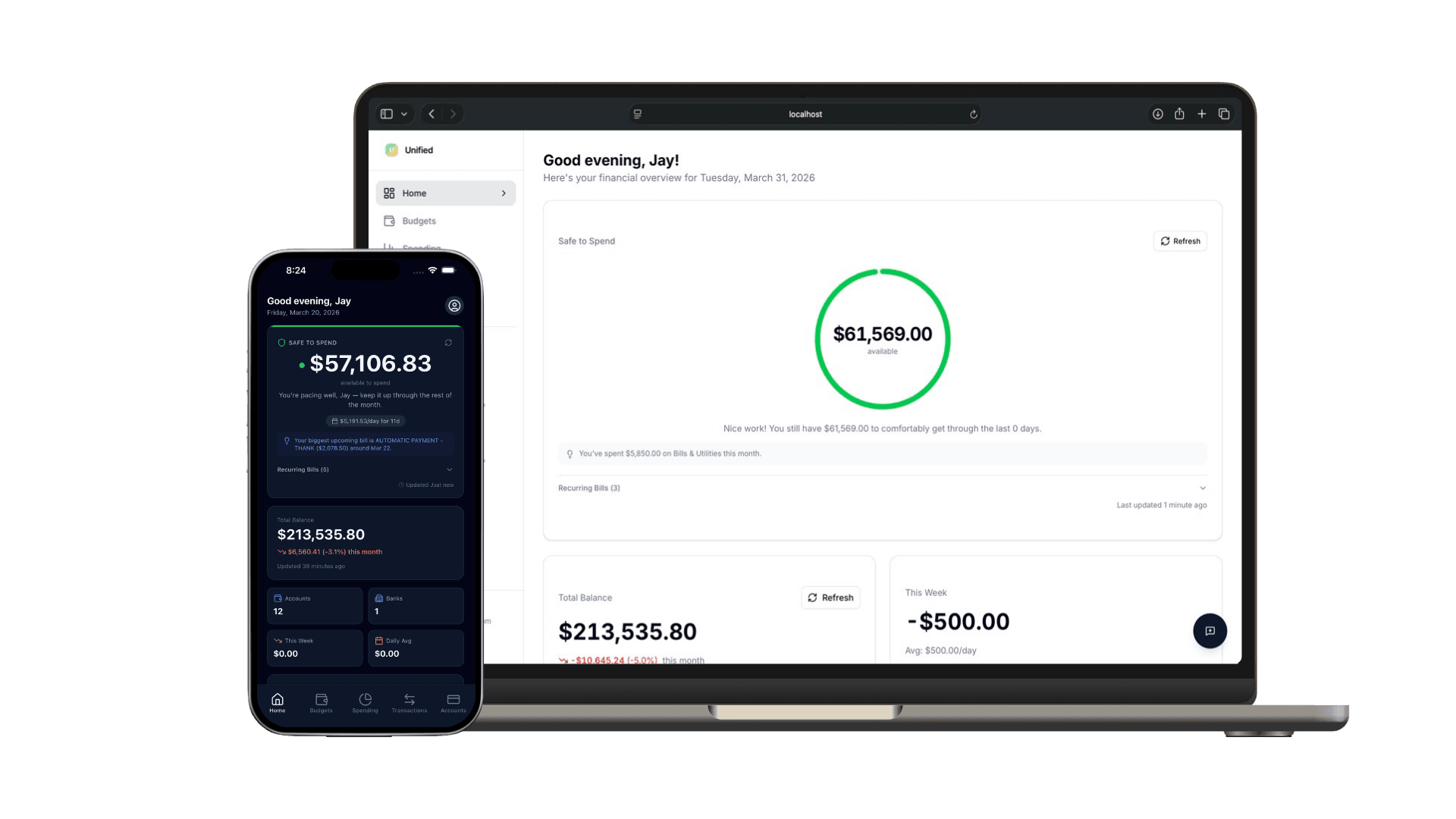
Price: 14-day free trial, then $6.99/mo or $69/yr
Best for: Any Canadian who wants to see all their bank accounts in one secure dashboard.
Wealthica — Best for Investment Focus
Wealthica specializes in investment portfolio aggregation. If your primary goal is tracking investments across multiple Canadian brokerages, Wealthica is worth considering. However, its day-to-day banking aggregation and spending analytics are limited compared to Unified.
Price: Free tier available (limited features)
Copilot Money — Best UX (US-Focused)
Copilot has a beautiful interface but was designed for the US market. Canadian bank support is inconsistent, and the app requires a paid subscription. Not recommended as a primary solution for Canadian bank aggregation.
Price: Paid subscription required
Pricing at a Glance
| App | Price (CAD) | Free trial |
|---|---|---|
| Unified | $6.99/mo or $69/yr | 14 days |
| Wealthica | Free tier (limited features) | — |
| Copilot Money | Paid subscription | — |
Feature Support at a Glance
| Feature | Unified | Wealthica | Copilot Money |
|---|---|---|---|
| Canadian bank sync | 15,000+ institutions | Limited (investment focus) | Inconsistent |
| TFSA/RRSP account support | Yes | Via brokerage connections | — |
| Net worth tracking | Yes | Investment portfolios | — |
| Subscription detection | Yes | — | — |
Common Bank Connection Combinations
Here are the most common multi-bank situations Unified solves:
TD + Tangerine Users
Many Canadians keep chequing at TD but use Tangerine for high-interest savings. Unified lets you see TD and Tangerine together in one dashboard.
RBC + Wealthsimple Users
Banking at RBC but investing at Wealthsimple? Connect both to see your complete financial picture — spending AND investing.
Scotiabank + Simplii Users
Scotiabank for everyday banking, Simplii for the no-fee benefits? Combine them.
CIBC + EQ Bank Users
CIBC for convenience, EQ Bank for the interest rate? See both balances without switching apps.
TD + RBC + BMO Users
Have accounts at multiple Big Five banks (mortgages, accounts, credit cards)? See TD, RBC, and BMO in one app — finally.
Credit Union + Big Bank Users
Bank with Desjardins or Meridian but also have accounts at TD or RBC? Unified connects both.
Step-by-Step: Connect All Your Banks with Unified
Here's exactly how to get all your Canadian bank accounts into one dashboard using Unified:
Step 1: Sign Up (30 Seconds)
Go to unifiedbankings.com/sign-up and create your account with email or Google. 14-day free trial to get started.
Step 2: Connect Your First Bank (60 Seconds)
From your dashboard, click "Connect a Bank" and select your financial institution from the list. You'll be directed to your bank's own secure login page through Plaid. Enter your banking credentials there — Unified never sees them. Then choose which accounts to link (chequing, savings, credit cards). You can connect all of them or select specific ones.
Step 3: Repeat for Each Bank (60 Seconds Each)
Add each of your remaining banks the same way — Tangerine, EQ Bank, Wealthsimple, and so on. Most users connect 2-4 institutions, often a mix like the common combinations above.
Step 4: See Your Complete Financial Picture
Once all banks are connected, your Unified dashboard immediately shows:
- Total net worth — all assets minus all liabilities across every institution
- All account balances — chequing, savings, credit cards, lines of credit — in one view
- Weekly spending chart — a day-by-day breakdown of spending across all accounts
- Recent transactions — from every connected bank, searchable by merchant, amount, or category
Step 5: Explore and Customize
Use Unified's features to get more from your financial data:
- Search transactions across all banks — type "Amazon" to see every Amazon purchase from every account
- Enable balance masking — hide your numbers when checking finances in public
- Review monthly analytics — see spending trends and category breakdowns over time
Benefits of Seeing All Your Accounts in One Place
Net Worth Clarity
When all your accounts are connected, you can see your true net worth at a glance. This single number — the total of everything you own minus everything you owe — is the most important metric in personal finance. Watching your net worth grow over time is motivating and keeps you focused on long-term financial health rather than short-term spending.
Spending Insights Across All Accounts
Financial fragmentation hides spending patterns. When your coffee purchases are split between your TD debit card, your RBC Visa, and your Tangerine credit card, you never see the full picture. With all accounts in one dashboard, you can instantly see that you're spending $280 a month on coffee across all payment methods — a revelation that changes behavior.
Time Saved
Logging into 3-5 banking apps every morning takes 10-15 minutes. With a bank aggregator, you open one app and see everything in seconds. Over a year, this saves you 60+ hours — more than a full work week.
Better Financial Decisions
When you can see all your money in one place, decisions become easier. Should you pay down the RBC credit card or build up the Tangerine savings account? With a complete view, the answer is obvious. Without it, you're guessing.
Reduced Financial Anxiety
Research consistently shows that financial awareness reduces money-related stress. The anxiety of not knowing — wondering if you forgot a payment, unsure if you have enough to cover next week — disappears when you have a clear, real-time view of your complete financial situation.
Find Hidden Money
That savings account you forgot about? The old RRSP at BMO from a previous job? When everything's visible in one dashboard, nothing hides.
Who Benefits Most from Bank Aggregation?
Couples Managing Joint + Individual Accounts
See his accounts, her accounts, and joint accounts in one view — no more reconciling two sets of banking apps at the end of the month.
Self-Employed and Freelancers
Business account at TD, personal at Tangerine, savings at EQ — freelancers often have complex setups. One dashboard simplifies everything.
High Earners with Multiple Accounts
The more money you have, the more scattered it becomes. Premium accounts, investment accounts, multiple credit cards — aggregation is essential.
FIRE (Financial Independence) Chasers
Tracking progress toward financial independence requires knowing your exact net worth. Aggregation makes this effortless.
Frequently Asked Questions
Can I see all my Canadian bank accounts in one app?
Yes. Unified connects all major Canadian banks — TD, RBC, BMO, CIBC, Scotiabank, Tangerine, and more — into one secure dashboard, so you can see balances, transactions, and net worth in a single view. Unified is strongest for everyday multi-bank aggregation; Wealthica is geared to investment portfolios, and a manual spreadsheet still works if you want full control with no third-party access.
Is it safe to connect all my bank accounts to one app?
Yes, when the app connects through Plaid, as Unified does. Plaid is a SOC 2 Type II certified infrastructure used by major fintech companies. Your bank passwords are handled entirely by Plaid and your bank — Unified never sees or stores them — and connections are read-only, so the app cannot move money. All data is encrypted with 256-bit encryption.
What is bank aggregation?
Bank aggregation is the process of connecting multiple bank accounts from different financial institutions into a single dashboard or app. Instead of logging into TD, RBC, BMO, and Scotiabank separately, a bank aggregator pulls your balances and transactions into one secure view through APIs from providers like Plaid.
Which Canadian banks can I connect?
Unified supports all Big Five Canadian banks (TD, RBC, BMO, CIBC, Scotiabank) plus Tangerine, Simplii Financial, and many other Canadian financial institutions through Plaid's extensive network. This includes chequing accounts, savings accounts, credit cards, and lines of credit.
How long does it take to connect all my banks?
With Unified, connecting each bank takes about 60 seconds. Most users have all their accounts connected and their complete financial dashboard visible within 5 minutes of signing up.
Can I see TD and RBC in one app?
Yes. Unified lets you connect TD, RBC, BMO, CIBC, Scotiabank, and many other Canadian banks to see all your accounts in one dashboard — no more switching between banking apps.
Does Unified work with credit unions like Desjardins?
Yes. Unified supports major Canadian credit unions including Desjardins, Meridian Credit Union, Vancity, Coast Capital, and Servus Credit Union.
Can I connect investment accounts like Wealthsimple?
Yes. Unified connects to Wealthsimple, Questrade, TD Direct Investing, RBC Direct Investing, and other Canadian investment platforms alongside your everyday bank accounts, so TFSA and RRSP balances are included in your net worth. If you only need deep investment analytics, Wealthica is a reasonable alternative.
Unified is a Canadian fintech company focused on simplifying personal finance management. Built specifically for the Canadian market, Unified enables Canadians to see their complete financial picture across multiple banking institutions in one secure location.
Related Articles
Open Banking in Canada, Explained
Where the regulated framework stands and what it changes.
GuideBest Chequing & Savings Accounts for Budgeting
Canadian accounts compared on fees, sub-accounts, exports and app support.
GuideFree Net Worth Tracker for Canadians
Track your net worth across all Canadian institutions for free.
ProductSupported Canadian Banks
TD, RBC, BMO, CIBC, Scotiabank, and hundreds more.
ComparisonPocketSmith Review for Canadians
Pricing in CAD, Canadian bank feeds, safety, and alternatives.
GuideBest Banking Apps in Canada (2026)
Big banks and online banks compared on the features you use daily.